Chart
Lino Printing Tools, Materials and Equipment: Full Checklist
Published
As an Amazon Associate we earn from qualifying purchases. This does not change our picks. Affiliate disclosure
Short answer
To start lino printing you need 7 things: a block, a lino cutter with a small V and a U blade, a brayer (roller), block printing ink, a flat slab to roll the ink on, a baren or wooden spoon, and thin smooth paper. A non-slip mat, a pencil, rags and soap come from the house. A press, a strop and a registration jig can wait.
Gear for this job
All 7 picks comparedSGHUO Beginner Linocut Kit
See price on AmazonSee it on AmazonSpeedball Deluxe block printing kit 3472
See price on AmazonSee it on AmazonBobblebro linocut kit, 4 blocks, 2.64 oz black ink
See price on AmazonSee it on Amazon
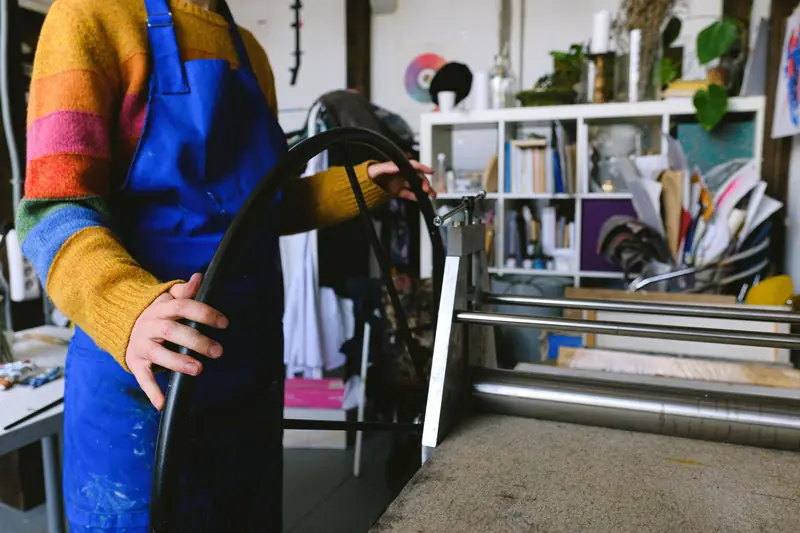
Linocut, also called lino printing or linoleum block printing, needs little gear, and part of it is already in the kitchen. This checklist is for someone about to buy for a first print who wants the complete list, not a product roundup. What decides the list is how you print. Printed by hand with a baren or a spoon, the setup stays small and the paper stays thin. A press, heavy paper and sharpening gear only matter once you print editions or more than one color.
Lino printing equipment list: every item in one table
The table covers the tools and materials for a one-color print made by hand, then the equipment to add later. Day one means you cannot pull a print without it. Where the house already holds a stand-in, the last column names it.
| Item | What it does | When | Household substitute |
|---|---|---|---|
| Linoleum block or soft carving block | The surface you carve and print from | Day one | None |
| Lino cutter with blades | Cuts away what stays white: V for lines, U for clearing | Day one | None |
| Bench hook or non-slip mat | Holds the block so the free hand stays behind the blade | Day one | A non-slip mat in place of a bench hook |
| Brayer (roller) | Rolls the ink into a thin film, then onto the block | Day one | None |
| Block printing ink | Thick ink made to be rolled out | Day one | Acrylic paint mixed with block printing medium |
| Inking slab | Flat, smooth surface for rolling out the ink | Day one | Glass from a picture frame, edges taped, or an acrylic sheet |
| Baren | Disc for rubbing the back of the paper so the ink transfers | Day one | Wooden spoon |
| Paper | Takes the print: thin and smooth for hand printing | Day one | Copy paper for test prints |
| Pencil, tracing or carbon paper | Puts the design on the block | Day one | A soft pencil tracing, laid face down and rubbed |
| Rags, sponge and soap | Cleans block, brayer and slab right after printing | Day one | Old rags and dish soap |
| Drying line or rack | Keeps wet prints apart while they dry | Day one | String and clothes pegs |
| Strop or slip stone | Keeps the cutting edges sharp | Later | None. Thin push-in blades are usually replaced |
| Registration jig, or pins and tabs | Lines up each color of a multi-color print | Later | A homemade corner jig |
| Press | Even pressure for heavy paper and long editions | Later | Baren or spoon with thinner paper |
What do you need for lino printing on day one?
Five items have no real stand-in: the block, the cutter, the brayer, the ink and the paper. The slab and the baren do, so the smallest working setup is five purchases plus what the house already has.
- Block: one small block. Soft rubber carves with little pressure, gray lino holds more detail. Speedball unmounted linoleum starts at 3 x 4 in.
- Cutter: one handle with a small V, a small U and a large U blade. The Speedball 6-piece set holds one handle and cutters #1, #2, #3, #5 and #6.
- Brayer: soft rubber suits general lino work. Speedball soft rubber brayers come in widths from 1.5 to 6 in.
- Ink: one tube of black water based block printing ink. It cleans up with soap and water.
- Paper: thin and smooth. One supplier guide gives about 40 to 160 gsm for printing by hand.
Note.Buying a kit? Read the contents list for a baren and paper. Kit listings often leave both out, and a wooden spoon and a pad of thin paper fill the gap.
What tools do you need for lino printing? The cutters
Three cuts cover most first prints. A V tool cuts lines and outlines. A U gouge clears the areas that stay white and leaves texture. A knife cuts clean edges and trims the block. A sensible first set is one small V, 1 to 2 mm wide, one small U, 2 to 3 mm, and one wide U of 5 mm or more.
Tools come in two forms: one handle with push-in blades that you swap, or fixed tools with a palm handle. Brands also name them differently. Speedball numbers are shape codes, not sizes: #1 is a Small V and #5 a Large U. A Pfeil code gives profile and width, so L 12/1 is a 60 degree V, 1 mm wide.
Note.Cut away from the hand that holds the block, and keep the block on a bench hook or non-slip mat. No tool is injury-proof.
Block, ink and paper: the materials you use up
The block decides how hard the carving is. Firm gray linoleum gives the most control and detail but needs more pressure, more still when it is cold. Soft blocks carve easily and do not crumble. Speedball unmounted linoleum is 1/8 in (0.3 cm) thick and takes water-soluble or oil-based ink.
For first prints on paper, water based block ink is the usual choice: it washes up with soap and water, and Essdee puts drying at about 2 hours on a warm rack. Water-washable oil ink stays workable longer and takes days to dry. Fabric needs fabric ink. Paper for hand printing is thin, about 40 to 160 gsm. A press handles 170 to 300 gsm.
Household substitutes that work, and where they stop
Pressure, a flat surface and a drying line are easy to borrow from the house. Cutting and inking are not: nothing in a kitchen drawer replaces a lino cutter or a brayer, because the ink has to go on as a thin rolled film.
- Baren: the back of a wooden spoon is the usual substitute. Rub in small overlapping circles over the whole image.
- Inking slab: the glass from a picture frame with tape over the sharp edges, or a sheet of acrylic. Any flat, smooth, non-absorbent sheet works.
- Drying rack: a length of string and clothes pegs, so the prints hang apart and do not touch.
- Ink: acrylic paint works only with a block printing medium. The mix given for Daler-Rowney System3 medium is 3 parts medium to 2 parts paint.
- Transfer paper: trace the design in soft pencil, lay the tracing face down on the block and rub the back.
Equipment needed for lino printing later on
None of these stops a first print. Each one answers a specific limit, so wait until you reach that limit before adding it.
| Add this | When it earns its place | Until then |
|---|---|---|
| Press | Heavy paper of 170 to 300 gsm, large solid areas, long editions | Baren or spoon on thin paper |
| Strop and slip | Fixed tools that you keep for years. One supplier guide says strop every 15 to 20 minutes of carving | Replace thin push-in blades |
| Registration jig, or pins and tabs | The first print with two or more colors | Print one color |
| Water-washable oil ink | Editions that need a longer working time on the slab | Water based block ink |
| Fine V and U tools | Detail finer than the starter blades can cut | Small V from the starter set |
Linocut supplies people forget: holding, cleaning, storing
The forgotten items are the small ones. A bench hook or non-slip mat keeps the block still while you carve. Rags, a sponge and soap need to be on the table before the ink comes out, because tools are cleaned at once, while the ink is still wet.
Two cleaning rules protect the gear. Do not soak a lino block: it can warp or swell, so wipe it and store it flat. Keep solvents off rubber rollers. If an ink needs solvent cleanup, use it with ventilation and follow the label.
Quick answers
Short answers to the questions people ask before buying. The checklist table at the top of the page has the full list with substitutes.
- What equipment do you need for lino printing? A block, a lino cutter, a brayer, block printing ink, an inking slab, a baren or wooden spoon, and thin paper. Add a non-slip mat, a pencil and rags.
- What tools do you need for lino printing? For carving, one small V, one small U and one wide U. For printing, a brayer and a baren. A wooden spoon can replace the baren.
- Do you need a press for lino printing? No. A baren or a wooden spoon prints thin, smooth paper of about 40 to 160 gsm. A press matters for heavier paper and editions.
- What can you use instead of a baren? A wooden spoon is the usual substitute. Rub the back of the paper in small overlapping circles.
- What do you roll lino ink on? A flat, smooth slab. Glass from a picture frame with taped edges or a sheet of acrylic both work.
Use this chart
Print it, save the image version, or put it on your own site or forum post with the code below. The code keeps a link back to this page as the source.
Embed code
<a href="https://inkedblock.com/blog/lino-printing-equipment-list"><img src="https://inkedblock.com/charts/lino-printing-equipment-list/image.png" alt="Lino Printing Tools, Materials and Equipment: Full Checklist" width="600" loading="lazy"></a>
<p>Source: <a href="https://inkedblock.com/blog/lino-printing-equipment-list">Lino Printing Tools, Materials and Equipment: Full Checklist</a>, Inked Block</p>
What you need for this
- See price on AmazonAmazon
SGHUO Beginner Linocut Kit
- See price on AmazonAmazon
Speedball 4131 Linoleum Cutter Set, 5 Types
From Best Lino Cutting Tool Sets: Handles With Interchangeable Blades
- See price on AmazonAmazon
Speedball Deluxe soft rubber brayer, 4 in
- See price on AmazonAmazon
Speedball water-soluble ink set, 6 x 1.25 fl oz