Comparison
Screen Printing Ink vs Block Printing Ink: Can You Swap Them?
Published
Short answer
Not as a straight swap. Block printing ink is a stiff, tacky paste made to be rolled into a thin film with a brayer. Screen printing ink is looser, made to be pulled through a mesh, so it slides under a rubber brayer and floods fine cuts. On fabric it can work if you put it on with a foam roller or dabber and heat set it as its label says.
The question usually comes from one of two places: a jar of fabric screen printing ink already on the shelf, or a store page where screen ink looks like the easier buy for T-shirts and tote bags. Both inks print on cloth, both can clean up with soap and water, and the jars look alike. The difference is in the body of the ink and in how the print is fixed to the fabric. This is the only page on the site that deals with screen printing ink, and only as a stand-in on a lino or rubber block. For everything else, the block inks are the ones to compare.
Screen printing ink vs block printing ink, row by row
The first three rows explain every problem people meet when they swap the two. The last three are what the makers state. Speedball makes both kinds, so its two fabric inks can be compared directly.
| Point | Block printing ink | Screen printing ink |
|---|---|---|
| Made for | Rolling onto a raised block with a brayer | Being pulled through a mesh screen with a squeegee |
| Body and tack | Stiff, tacky paste. Rolls out to a thin, velvety film | Looser, with little tack |
| Under a rubber brayer | Picks up evenly, with a light hiss | Tends to slide and go on unevenly |
| On paper | Speedball Water-Soluble ink: designed for paper | Speedball: its fabric screen inks also print on paper and cardboard |
| On fabric | Speedball fabric block ink: no heat set required, dry to the touch overnight | Speedball fabric screen ink: permanent if properly heat set |
| Cleanup | Speedball: soap and water for its water-soluble, fabric and relief inks | Speedball fabric screen ink: soap and water |
Can you use screen printing ink for block printing?
You can get a print, but the ink works against you. A brayer needs ink with tack: the stickiness that lets the roller pick up a thin, even layer and lay it on the raised surface only. Rolled out, block ink looks velvety and makes a light hiss. Screen printing ink is built for the opposite job. It has to flow through the open mesh of a screen under a squeegee, so it is looser and has little grip.
On a slab that shows at once. The ink smears instead of rolling out, the brayer skids, and what reaches the block is uneven. Where it goes on thick it runs into fine lines and fills them, which is the same fault as too much ink of any kind. Bold designs with wide cuts survive this. Fine linework does not. The roll-out that block ink should give is described in how to use a brayer.
How to apply screen printing ink to a lino block
If the screen ink is what you have, change the way it goes on. These are common workarounds among printmakers, not maker instructions, and none of them turns screen ink into block ink. Try them on a scrap of the same fabric or paper first.
- Swap the rubber brayer for a dense foam roller, or dab the ink on with a foam dabber or sponge. Foam carries loose ink that a rubber roller pushes around.
- Spread the ink on the slab and let it sit for a short while so it thickens before you load the roller.
- Put on a thin coat and re-ink for every print. A heavy coat floods the cuts and blurs the edges.
- Choose a block with bold shapes and wide cleared areas. Keep fine lines for block ink.
- Wash the block, roller and slab with soap and water as soon as you stop, before the ink dries on them.
Fabric ink for block printing: two ways it is fixed
This is where the two Speedball inks part. Its Fabric Block Printing Ink has a water-washable oil base. Speedball says it needs no heat set and is dry to the touch overnight, and listings say to wait about a week before the first wash. Its Fabric Screen Printing Ink is described as permanent if properly heat set, so the print is not finished until it has been ironed or otherwise heated as the label says.
Essdee takes the heat-set route for block ink too: its fabric block printing inks bond to the fabric once dried and heat set. So the rule is not block ink against screen ink. It is: read how your ink is cured and do exactly that. Nothing on this page promises that a print will survive washing. The ink chart shows each block ink by surface, and how to block print on fabric covers the printing itself.
Water based screen ink or plastisol?
Everything above is about water based screen printing ink sold for home use, the kind that cleans up with soap and water. Print shops mostly use plastisol on garments, and that is a different material: PVC particles in a plasticizer. It is not water-soluble, it does not dry in the air, and most plastisols must reach about 180 C (350 F) to cure. It is not an ink for a lino block at a kitchen table. If a jar does not say how it dries and how it cleans up, do not put it on a brayer.
Choose block printing ink when
Block ink is the default for anything carved. It is the only one of the two made to be rolled, and for cloth there is a fabric version of it.
- You print on paper. Water based block ink or a water-washable oil based relief ink is made for it. See oil based vs water based ink.
- The block has fine lines or small text. Only a thin, tacky film stays on the surface and out of the cuts.
- You print fabric and do not want to heat set. Speedball fabric block ink is dry to the touch overnight with no heat set required.
- You are buying ink anyway. An ink sold as fabric block printing ink is made for the brayer and block you already have.
Choose screen printing ink when
Screen ink earns a place on a block in a few narrow cases. In all of them the design is simple and you accept a softer edge than block ink gives.
- You already own fabric screen printing ink and want to try a block on cloth before buying anything.
- The design is bold: large shapes, wide cuts, no fine linework. A foam roller or dabber can ink that evenly enough.
- You are set up to heat set. Speedball calls its fabric screen ink permanent only if properly heat set.
- You print paper or cardboard with the same jar. Speedball says its fabric screen inks print well on both.
Note.Acrylic paint is a third substitute people reach for. On paper it needs a block printing medium: Daler-Rowney System3 medium is mixed 3 parts medium to 2 parts paint.
Quick answers
Short answers on fabric inks for blocks. Curing and washing follow the label of the ink you bought, and no maker statement here is a guarantee.
- What is the best block printing ink for fabric? An ink sold as fabric block printing ink. Speedball's needs no heat set. Essdee's is heat set after drying. Screen ink is a stand-in, not the first choice.
- Is textile block printing ink the same as fabric screen printing ink? No. Both are for cloth, but block ink is stiff and tacky for a brayer, and screen ink is loose so it passes through a mesh.
- Can block printing fabric paints or acrylics replace fabric ink? On paper, acrylic paint with a block printing medium works. No maker statement was found for that mix on fabric, so test first.
- Can you use block printing ink for screen printing? It is not made for it. Block ink is a stiff paste meant to sit on a raised surface, not to flow through a mesh.
What you need for this
 See price on AmazonAmazon
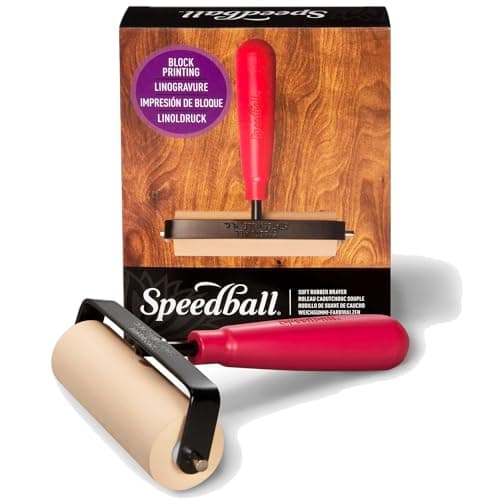
Speedball Deluxe soft rubber brayer, 4 in
 See price on AmazonAmazon
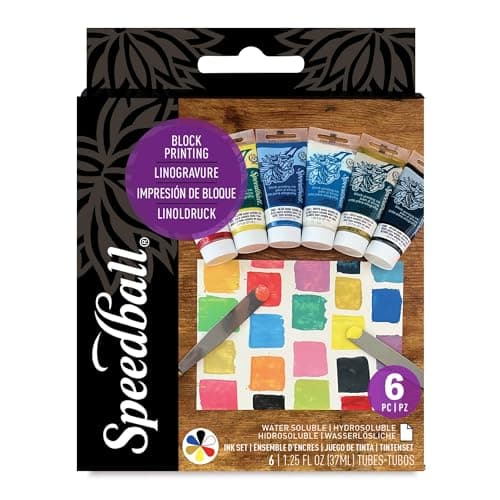
Speedball water-soluble ink set, 6 x 1.25 fl oz
 See price on AmazonAmazon
Caligo Safe Wash relief ink, black, 75 ml
From Best Oil Based Block Printing Inks, Including Water-Washable