How-to
How to Use a Brayer: Rolling Out Ink for Block Printing
Published
As an Amazon Associate we earn from qualifying purchases. This does not change our picks. Affiliate disclosure
Short answer
Put a short line of ink on a smooth slab and roll it out in different directions, lifting the brayer between passes, until the film is thin, even and velvety and makes a light hiss, not a squelch. Then ink the block in several light passes from different directions, picking up fresh ink from the slab between passes.
Gear for this job
All 6 picks comparedSpeedball Deluxe soft rubber brayer, 4 in
See price on AmazonSee it on AmazonSpeedball soft rubber brayer, 3 in
See price on AmazonSee it on AmazonQWORK soft rubber brayer, 6 in, steel frame
See price on AmazonSee it on Amazon
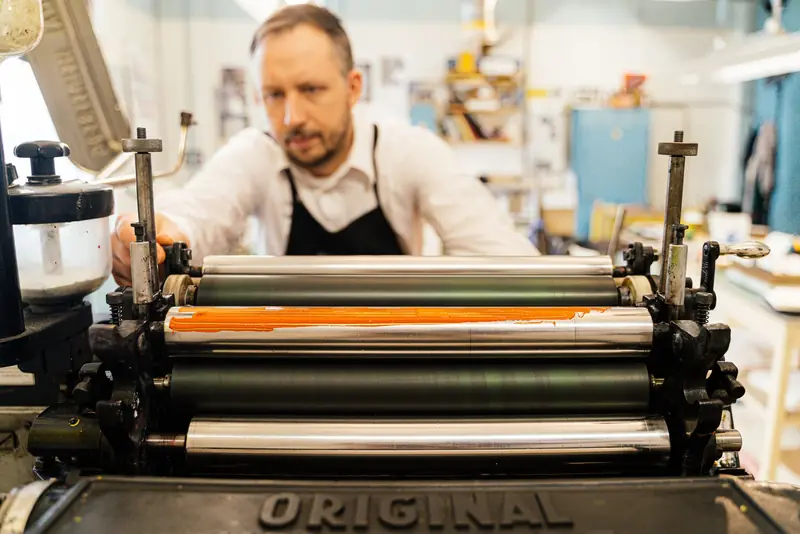
A brayer is the hand roller used to ink a printing block. In the UK it is simply called a roller. This page is for anyone who has bought one for linocut or block printing and is not sure how much ink to use or how to roll it. A brayer does not spread ink the way a paint roller does. It picks up a thin film from a slab and lays that film on the raised surface of the block. Almost every inking fault, from pale speckled prints to filled-in lines, starts on the slab, so most of the work happens there.
What is a brayer used for?
In art, a brayer is a rubber cylinder that spins on a frame with a handle. In block printing it has one main job: to carry an even film of ink from the slab to the block. A clean brayer is also used to press paper or fabric onto an inked block.
Brayers differ in width and in the hardness of the rubber. Soft rubber suits general lino work. Width matters as much: a brayer at least as wide as the block inks it without leaving edge lines. Sizes and models are compared in the brayer guide.
| Brayer | Hardness | Maker lists it for |
|---|---|---|
| Speedball soft rubber | 40/42 durometer, widths 1.5 to 6 in | linoleum, soft block and woodcut |
| Speedball hard rubber | 72 durometer | light carving, rolling down prints, gluing |
| Essdee rollers | 25 Shore (very soft) to 70 Shore (hard) | a range of hardness across the line |
How much ink to put on the slab
Less than you expect. Squeeze a line of ink about as long as the brayer is wide across the top of the slab. Start with that and add more in small dabs as the film thins. It is easier to add a little ink than to take it off, and too much ink is the usual cause of filled-in lines and blobs.
The slab must be smooth and must not soak up ink: a sheet of glass with taped edges, an acrylic sheet or a smooth inking tray. It should be wider than the brayer so you can roll in two directions. The same setup serves every ink type in the ink chart.
How to roll out ink and ink the block
The same routine works for water based ink, water-washable oil ink and acrylic paint mixed with medium. Have the block and paper ready first, because water based ink starts to dry once it is rolled thin.
- 1
Squeeze a line of ink across the top of the slab, about as long as the brayer is wide. Keep it clear of the area where you will roll.
- 2
Touch the brayer to the line, pull a little ink down and roll it out with short forward strokes. Lift the brayer at the end of each stroke so the roller spins and lands on a new part of its surface.
- 3
Change direction. Roll up and down, then side to side, lifting between passes, until the ink forms an even square a little wider than the brayer.
- 4
Check the film. It should look thin and velvety with a fine, even texture and sound like a light hiss. If it squelches, scrape some ink off the slab and roll again.
- 5
Ink the block in light passes, using only the weight of the brayer. Roll across the whole block, then reload from the slab.
- 6
Repeat from a different direction each time, for 3 or more passes, until the raised surface has an even satin sheen with no dry areas.
- 7
Tilt the block toward a light. Dull spots need another pass. Shiny wet ridges mean too much ink: print once on scrap paper to take it off.
What the right ink film looks and sounds like
The slab tells you whether the block is ready before you print anything. Look across the film at a low angle and listen as the brayer rolls. The job is done when the raised surface of the block has the same thin, even sheen as the slab and the carved areas are still clean.
| On the slab | What it means | What to do |
|---|---|---|
| Light hiss, velvety film with a fine even texture | Right amount of ink | Ink the block |
| Wet squelch, ridges or peaks in the film | Too much ink | Scrape some off with a palette knife and roll out again |
| Almost silent, slab shows through in streaks | Too little ink | Add a small dab from the line and roll out again |
| Film drags, tacky lumps, dry edges | Ink is drying on the slab | Scrape it off and roll out fresh ink |
How to avoid roller marks on the block
Roller marks are lines or bands of heavier or lighter ink. Most come from three habits: pressing down, rolling in one direction only, and using a brayer narrower than the block without overlapping the passes. Pressing squeezes ink out past the ends of the roller and leaves a ridge. Rolling one way repeats the same band on every pass.
A brayer also runs out of ink. It carries one turn of ink, so on a block longer than that the second turn lays down less. Reload from the slab and start the next pass from the other end. Finish with one light pass and lift off beyond the edge of the block instead of stopping on it. If prints still come out uneven, work through why a lino print is patchy.
Cleaning a brayer and storing it off its rubber
Clean the brayer as soon as you stop. Water based ink comes off with soap and water. Essdee tells users of its rollers to wash them in warm water with detergent and never to use solvents, which break the rubber down. Water-washable oil ink cleans up with liquid soap first, then water. Dried ink is a separate job: see cleaning dried ink off brayers.
Never leave a brayer resting on its rubber, during a session or in storage. Essdee recommends hanging a roller by the hole in its handle, or laying it on its back so the rolling surface touches nothing. A roller left sitting in ink or on the table can pick up a flat spot or a dent, and that mark prints as a gap on every pass.
Quick answers
Short answers to the common brayer searches. Hardness figures are the makers' own, and the routine is the same for any block ink.
- What is a brayer in art? A hand roller with a rubber cylinder on a handle. Printmakers use it to roll ink into a thin film and lay it on a block. In the UK it is called a roller.
- How do you use a brayer roller? Roll a short line of ink out on a smooth slab until it is thin and hisses lightly, then roll the block in several light passes from different directions.
- What is a brayer used for besides inking? A clean one presses paper or fabric onto an inked block, and rolls down prints and glued paper in craft work.
- Which brayer application techniques prevent streaks? Use light pressure, change direction on every pass, reload from the slab, and lift off past the edge of the block.
- Soft or hard brayer for lino? Soft rubber suits general lino work. Speedball lists its soft rubber brayer at 40/42 durometer.
What you need for this
- See price on AmazonAmazon
Speedball Deluxe soft rubber brayer, 4 in
- See price on AmazonAmazon
Speedball water-soluble ink set, 6 x 1.25 fl oz
- See price on AmazonAmazon
Caligo Safe Wash relief ink, black, 75 ml
From Best Oil Based Block Printing Inks, Including Water-Washable