How-to
How to Carve Your Own Stamps From Lino and Rubber Blocks
Published
Short answer
Carve stamps from a soft rubber block, or from a plain eraser for tiny ones. Transfer the design reversed, outline it with a small V tool, clear the background 1 to 2 mm deep, cut the stamp out with a knife and mount it on wood or acrylic. Ink it by tapping a stamp pad on the face: a paper pad for cards, a fabric pad that is heat set for cloth.
A stamp is a small block print made to be repeated: on cards, envelopes, gift wrap, tote bags. The carving is the same as for any linocut. Three things change. The block is usually soft rubber, not gray linoleum, because it gives a little and prints with hand pressure alone. The carved image is cut out of the sheet and mounted, so it has a handle and a flat back. And the ink usually comes from a stamp pad, not from a brayer and slab. This page takes each change in turn and lists the ink pad types by what their maker says they print on.
Which block to use for linocut stamps
For linoleum block stamps the usual choice is not linoleum at all. Soft rubber blocks carve with little pressure, do not crumble, and can be cut into shapes with a knife. Their weak point is that they can stretch slightly under the tool, so very fine detail is harder to hold. Blocks by size, thickness and pack count are compared in the soft carving blocks guide.
| Block | What the maker says | Suits |
|---|---|---|
| Speedball Speedy-Carve (pink) | Easy to carve, takes fine lines without crumbling, can be cut into pieces | Detailed stamps. Water-soluble or oil-based ink |
| Speedball Speedy-Cut | Soft rubber for young students and beginners, moderate detail | Simple shapes. Water-soluble ink only |
| Essdee MasterCut | Soft, flexible, rubber-like. Called great for stamp making | Shapes cut out with a craft knife |
| Gray linoleum, 1/8 in | Speedball: for water-soluble or oil-based ink | Flat, detailed stamps. Needs a mount and firm pressure |
| Plain eraser | No maker statement | Tiny stamps: initials, dots, stars |
Note.Speedball allows only water-soluble ink on Speedy-Cut. Keep to water based pads and inks on it, and check the wrapper of any other soft block before using a solvent pad.
How to carve a stamp, step by step
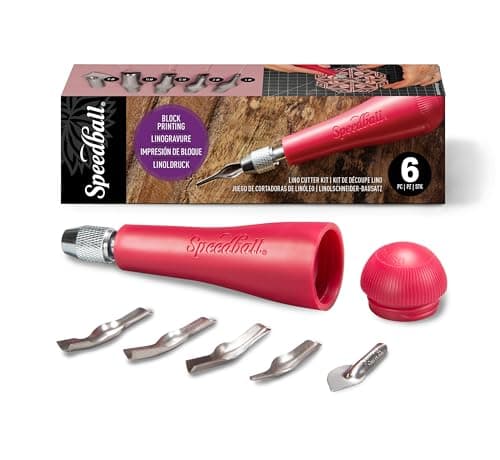
You need a small V tool, a U gouge and a knife. The tool size chart shows which blade is which in each brand. Grip, angle and safe hand position are covered in how to carve a linoleum block.
- 1
Draw the design at its final size with a soft pencil on tracing paper. Keep shapes bold: hair-thin lines are hard to hold in soft rubber.
- 2
Lay the tracing face down on the block and rub the back with a spoon until the graphite has moved across. The image is now reversed on the block, so it will stamp the right way round.
- 3
Outline every shape with a small V tool, 1 to 2 mm wide. Cut on the waste side of the line with light pressure, and lean the tool so the walls slope away from the image.
- 4
Clear the background with a U gouge, 2 to 3 mm wide for small stamps, to a depth of 1 to 2 mm. Leave nothing standing level with the image.
- 5
Cut the stamp out of the sheet with a craft knife or the Speedball #6 knife. Trim close to the image, a few millimeters away, so no spare edge can pick up ink.
- 6
Mount the stamp on a wood or acrylic block cut slightly larger than the rubber, using double-sided tape pressed down firmly over the whole back.
- 7
Ink the stamp and make 3 test prints on scrap paper. Cut away anything that prints but should not, then test again.
Why a toner transfer is not for soft blocks
On traditional lino a laser print or photocopy can be ironed on through baking parchment. Do not do this on a soft block: the heat warps it. For rubber, use the rubbed-down pencil tracing from step 2, carbon or graphite paper, or draw straight on the surface. Speedball's Speedy-Carve kit includes a sheet of tracing paper for transfers. Each method, with what it works on, is in how to transfer a design to a block.
Mounting a stamp on wood or acrylic
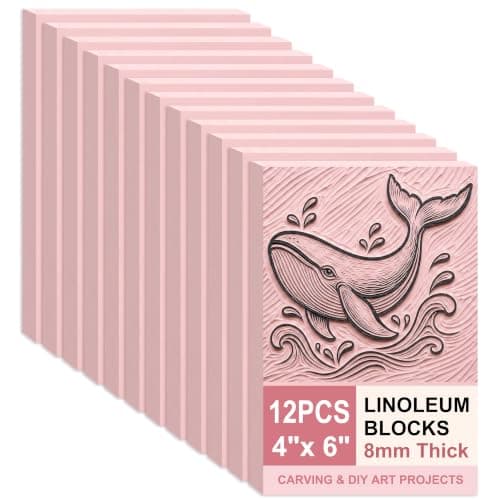
A mount does three jobs. It gives you a handle, spreads the pressure of your hand evenly, and keeps thin rubber or lino from bending as it prints. Thin material needs it most: gray linoleum is only 1/8 in thick. Some soft blocks are sold 8 mm thick, which is enough to grip and print without a mount.
Wood is the simple choice. Stamp the image once on the top of the block so you know which stamp it is and which way is up. Clear acrylic lets you see through the mount, which makes it easier to place repeats and borders. In both cases the mount should be only slightly larger than the stamp, or its edges will tip into the ink.
Inking with a stamp pad instead of a brayer
Lay the stamp face up and tap the pad onto it with light, overlapping taps. This way a small pad can ink a stamp larger than itself. Look across the surface: the whole image should carry an even sheen, with no ink sitting in the cuts. Press the stamp straight down on the paper, hold for a second or two, then lift straight up.
Put a few sheets of paper under the sheet you are stamping. The slight give helps the stamp meet the surface all over. For a stamp too large for a pad, roll out block printing ink with a brayer in a thin, even film, as for any print.
Ink pad types and what they print on
Pads differ by ink, not by size. The rows below quote one pad maker, Tsukineko, on its own pads, and Speedball on the two block inks you would roll on. Other brands use other formulas, so read the label of the pad you buy. For block inks on every surface, see the block printing ink chart.
| Pad or ink | Prints on, per maker | Drying and setting, per maker |
|---|---|---|
| Oil based pigment pad (Tsukineko VersaFine) | Uncoated paper, cardstock, washi | Dries in 3 to 5 seconds on uncoated paper. On fabric it may fade when washed |
| Water based pigment craft pad (Tsukineko VersaCraft) | Fabric, wood, cardstock, washi, leather, unglazed pottery | Fabric: iron through a pressing cloth at the cotton setting for 15 seconds or longer |
| Solvent dye pad (Tsukineko StazOn) | Metal, plastic, glass, ceramics, glossy and plain paper | Dries in 3 seconds to 5 minutes. May bleed on cloth and untreated wood |
| Water-soluble block ink, rolled on (Speedball) | Paper | No drying figure on the product page. Soap and water cleanup |
| Fabric block ink, rolled on (Speedball) | Fabric | Dry to the touch overnight, no heat set required |
Note.Tsukineko says that even after heat setting, color may gradually fade with repeated washing, depending on the fabric. Follow the label and test a scrap. Nothing here promises a print will survive the wash.
How to tell the stamp is finished
The test print tells you. Stray marks around the image come from ridges in the background or from a corner of the rubber: cut them lower or trim them off. Fuzzy outlines mean too much ink or too much pressure, not a carving fault. A pale patch in the same place on every print means the face is not flat, usually because the tape under it is uneven.
The stamp is done when three prints in a row show the whole image, clean edges and nothing else. After use, wipe water based ink off with a damp cloth before it dries, and do not soak a lino stamp, because lino can warp or swell. For its solvent pad, Tsukineko says to remove the ink with the maker's cleaner as soon as possible. Printing stamps on cloth is covered in how to block print on fabric.
Quick answers
Short answers on blocks, kits and ink for hand-carved stamps. Maker statements are named, and none of them is a wash guarantee.
- Can you make linocut stamps from real linoleum? Yes. Gray lino holds fine detail, but it is thin and firm, so mount it and press harder than with rubber. Soft blocks are easier for most stamps.
- Can you carve a linocut eraser stamp? Yes. A plain eraser carves like a soft block and suits tiny stamps such as initials or stars. Use the smallest V tool and a knife.
- What is in a linocut stamp kit? Speedball's Speedy-Carve kit holds a 4 x 6 in block, a wooden handle, #2 and #4 cutters and tracing paper. Ink or a pad is bought separately.
- Do block printing stamps work on fabric? With a fabric ink, yes. Tsukineko heat sets its VersaCraft pad with an iron. Speedball fabric block ink needs no heat set.
- What are good linocut stamp ideas for a first try? Bold shapes with no thin lines: leaves, stars, a border repeat, or initials. Remember that letters are carved reversed.
What you need for this
 See price on AmazonAmazon
SGHUO pink rubber blocks, 4 x 6 in, 8 mm, 12 pieces
 See price on AmazonAmazon
Speedball 4131 lino cutter set, 5 cutters and handle
From Best Lino Cutting Tool Sets: Handles With Interchangeable Blades
 See price on AmazonAmazon
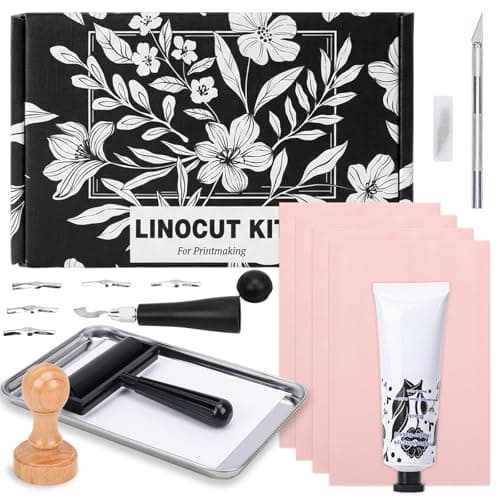
SGHUO linocut kit, 4 pink 4 x 6 in blocks, 3.5 oz ink